

Proof of Stake Explained
- Aditya Chopra

- Jan 11, 2021
- 4 min read
Updated: Jun 15, 2021

What is Proof of Stake (PoS)?
The concept of Proof of Stake (PoS) states that according to how many coins he or she holds, a person can mine or validate block transactions. This implies that the more a miner owns Bitcoin or Altcoin, the more mining power he or she has.
KEY POINTS
With Proof of Stake (POS), based on the amount of Bitcoin a miner holds, Bitcoin miners can mine or validate block transactions.
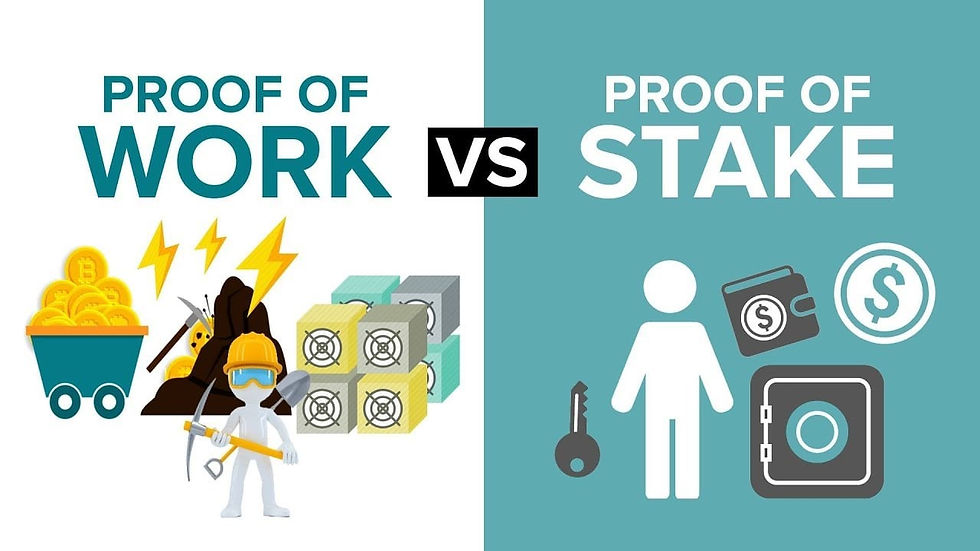
Proof of Stake (POS) was developed as an alternative to Proof of Work (POW), which is the initial Blockchain technology consensus algorithm, used to confirm transactions and add fresh blocks to the chain.
Proof of Work (POW) requires enormous amounts of energy, with miners having to sell their coins in order to ultimately pay the bill; Proof of Stake (PoS) provides mining power based on a miner's percentage of coins held.
In terms of the potential for miners to attack the network, Proof of Stake (POS) is seen as less risky, as it structures compensation in a way that makes an attack less advantageous to the miner.
Understanding Proof of Stake (PoS)
As an alternative to the proof of work (PoW), the proof of stake was created to address inherent problems in the latter. The transaction data is fitted into a block with a maximum capacity of 1 megabyte when a transaction is initiated and then duplicated across multiple computers or nodes on the network. The nodes are the blockchain's administrative body and verify the legitimacy of the transactions in each block. The nodes or miners would need to solve a computational puzzle, known as the proof of work problem, to carry out the verification step. The first miner to decipher each block transaction issue is rewarded with a coin. Once a transaction block has been verified, it is added to the public transparent ledger, the blockchain.
To run various cryptographic calculations to unlock the computational challenges, mining requires a lot of computing power. The computing power translates into a large quantity of electricity and energy required to prove the work. In 2015, the amount of electricity needed to power 1.57 American households per day was estimated to require one Bitcoin transaction. Miners would usually sell their awarded coins for fiat money to foot the electricity bill, which would lead to a downward movement in the cryptocurrency's price.
By attributing mining power to the proportion of coins held by a miner, the Proof of Stake (PoS) seeks to address this issue. In this way, a PoS miner has limited to mining a percentage of transactions that reflects his or her ownership stake, instead of using energy to answer PoW puzzles. A miner who owns 3% of the Bitcoin available, for instance, can theoretically mine only 3% of the blocks.
How does PoS work?
A pseudo-random selection process is used by the Proof Of Stake algorithm to select a node to be the next block's validator, based on a combination of factors that could include the staking age, randomization, and wealth of the node.
It is good to note that blocks are said to be "forged" rather than mined in Proof of Stake systems. Proof of Stake cryptocurrencies often begins by selling pre-mined coins or launching with the Proof of Work algorithm and later switching to Proof of Stake.
Where more and more cryptocurrency is generated in Proof of Work-based systems as rewards for miners, the Proof-of-Stake system usually uses transaction fees as a reward.
Users who want to participate in the process of forging are required to lock a certain amount of coins as their stake into the network. The size of the stake determines the chances that a node will be chosen to forge the next block as the next validator - the bigger the stake, the greater the chances. More unique methods are added to the selection process in order for the process not to favour only the wealthiest nodes in the network. 'Randomized Block Selection' and 'Coin Age Selection' are the two most commonly used methods.
The validators are selected by searching for nodes with a combination of the lowest hash value and the highest stake in the Randomized Block Selection method, and since the size of stakes is public, other nodes can usually predict the next forger.
Based on how long their tokens have been staked for, the Coin Age Selection method chooses nodes. By multiplying the number of days the coins have been held as a stake by the number of coins that are staked, the coin age is calculated. Their coin age is reset to zero once a node has forged a block and they have to wait a certain period of time to be able to forge another block - this prevents the blockchain from being dominated by large stake nodes.
For what they believe is the best possible combination for them and their users, each cryptocurrency using the Proof of Stake algorithm has its own set of rules and methods combined.
It checks if the transactions in the block are valid, signs the block, and adds it to the blockchain when a node is chosen to forge the next block. The node receives the transaction fees that are linked to the transactions in the block as a reward.
If a node wants to stop being a forger, its stake is released after a certain period of time along with the earned rewards, giving the network time to verify that there are no fraudulent blocks added by the node to the blockchain.


Comments